Employer brand: employee experience reshapes your hiring


 5 min read
Employer brand: employee experience reshapes your hiring
65% of executives believe employee experience affects profitability. Only 24% actually measure it. In that gap, your employer brand pays the bill, and your hiring slows down.
The figure comes from the 2025 Employee Experience Barometer by Parlons RH, the eighth edition of its kind. It says two things at once. Executives have understood that the topic hits the business. But the quantified proof never lands on the leadership table. The result: career pages that ring hollow, candidates who check your promise within forty-eight hours through Glassdoor or LinkedIn, and internal teams that feel the gap before anyone else. What is at stake here is not yet another HR topic, it is the alignment between what you say and what your employees actually tell.
The topic is no longer soft, it is strategic
For years, employee experience was filed under wellness. Nap rooms, organic fruit, wall murals. In 2026, the numbers settle it.
70% of active companies report growth over three years, versus 34% of non-active ones. 55% have grown headcount, versus 39%. 83% post strong social performance, versus 52%. Gallup confirms it, across 183,806 teams tracked: the top quartile delivers 23% more profit than the bottom quartile, and 70% of engagement variance depends on direct management.
The paradox flagged by Parlons RH: 84% of active, growing companies do not connect their results to their employee experience actions. The lever works, it stays invisible even to those pulling it. Which means, in most boardrooms, the topic keeps being treated as nice-to-have while the data shouts otherwise.
Internal reality is your real employer brand
An employer brand is not a "our values" page. It is a daily story your employees carry, share, sometimes call out. Glassdoor never sleeps, neither does LinkedIn. A botched onboarding means twenty direct contacts learning within the week that your promise does not hold.
Think of the color of a painted wall. If you pick a beautiful pantone for the career site but the actual wall is taupe gray, the candidate sees it the moment they walk in. No internal newsletter bridges the gap. In a tight market, that mismatch shows up directly in your candidate acquisition cost, your time-to-hire, and, a few months later, in the retention numbers of the people who did accept the offer.
Real case: the mid-size firm that did not understand its turnover
Mid-size industrial company, 120 employees, 18% annual turnover. The employer brand lead launches a "They share their story" page with three smiling portraits shot on a Friday. Studio, coffee, flattering light. The career site gets a new face.
Six months later, turnover has not moved. She picks the file up differently. She interviews everyone who leaves. Three tough findings: newcomers lose their footing between day 60 and day 90, returns from maternity leave go badly in two departments, the yearly review plays as ritual more than useful dialogue.
She rewrites the career page around these three angles. Not to hide them, to show how they are addressed. Day-by-day onboarding path with named buddies. Return-from-leave protocol signed by the HR director. A redesigned yearly review, manager testimonial included. Three months later, spontaneous applications up 34%. The cost of replacement estimated at 25,000 euros per position becomes a budget argument the executive team can read.
Nothing was invented. The honesty of the story is what made the career page credible.
Three moments, not thirty indicators
The classic trap: aligning employee experience with a marketing ROI grid, and building a thirty-row dashboard nobody knows how to read. The right question is not "how do we measure everything" but "what actually counts, and how do we tell it to leadership?".
Pick three moments. Onboarding: what happens at 30, 60 and 180 days? Transitions: promotion, return from leave, change of manager. Exit: because the former employee will tell your story for ten years. Document them, measure them, make them visible in your HR communication. A career site that talks about integration as a real story is worth five "our commitments" pages. And because these three moments leave hard traces in your ATS, your HRIS, and in the conversations managers already have, you do not need a new platform to start. You need the discipline to pay attention.
Exercise: the 180-day test
Do it this week. Pick your last five hires. Private message, not anonymous form. One question: "On your first 180 days, what happened as announced, what surprised you?" The answers give you the raw material for your next career page. Not to polish, to tell it straight.
Employee experience is not yet another HR project. It is the raw material of your employer brand, and therefore of your hiring. When it is good, your employees become ambassadors without being asked. When it breaks, no campaign bridges the gap.
If you are rethinking your career site and your HR communication starting from this lived reality, Paradisiak can help you turn that material into pages that stand on their feet.
Boost the performance of your recruitment
An exceptional career site to enhance your employer brand and captivate your future talents
Frequently asked questions
What is employee experience?
Employee experience covers the full journey of a worker inside the company, from application to exit. It includes onboarding, management relationships, tools, transitions and offboarding. It is not an isolated HR project, it is the sum of daily interactions that shape the real fabric of a company.
How does employee experience impact the employer brand?
Internal reality does not stay internal. It leaks onto Glassdoor, LinkedIn, TikTok. If your career page promises autonomy but the lived reality is micro-management, the candidate sees it within forty-eight hours. The employer brand is not what you display, it is what people live, translated into communication.
What is the impact on company performance?
The Parlons RH 2025 Barometer is clear. 70% of companies active on employee experience report growth over three years, versus 34% of the non-active ones. Gallup adds that the most engaged teams deliver 23% more profit than the least engaged. The impact is statistical, not anecdotal.
How do you measure employee experience?
You combine quantitative and qualitative signals. Quantitative: turnover, absenteeism, engagement score, cost of replacement. Qualitative: exit interviews, 30, 60 and 180-day check-ins, verbatim on key moments. Three well-chosen indicators beat a twenty-row dashboard nobody reads.
Which key moments concentrate the impact?
Three moments. Onboarding, assessed at 30, 60 and 180 days. Transitions: promotion, return from parental leave, change of manager. And the exit, too often rushed even though it shapes what the former employee will tell for ten years. Get those three right before spreading yourself thin.
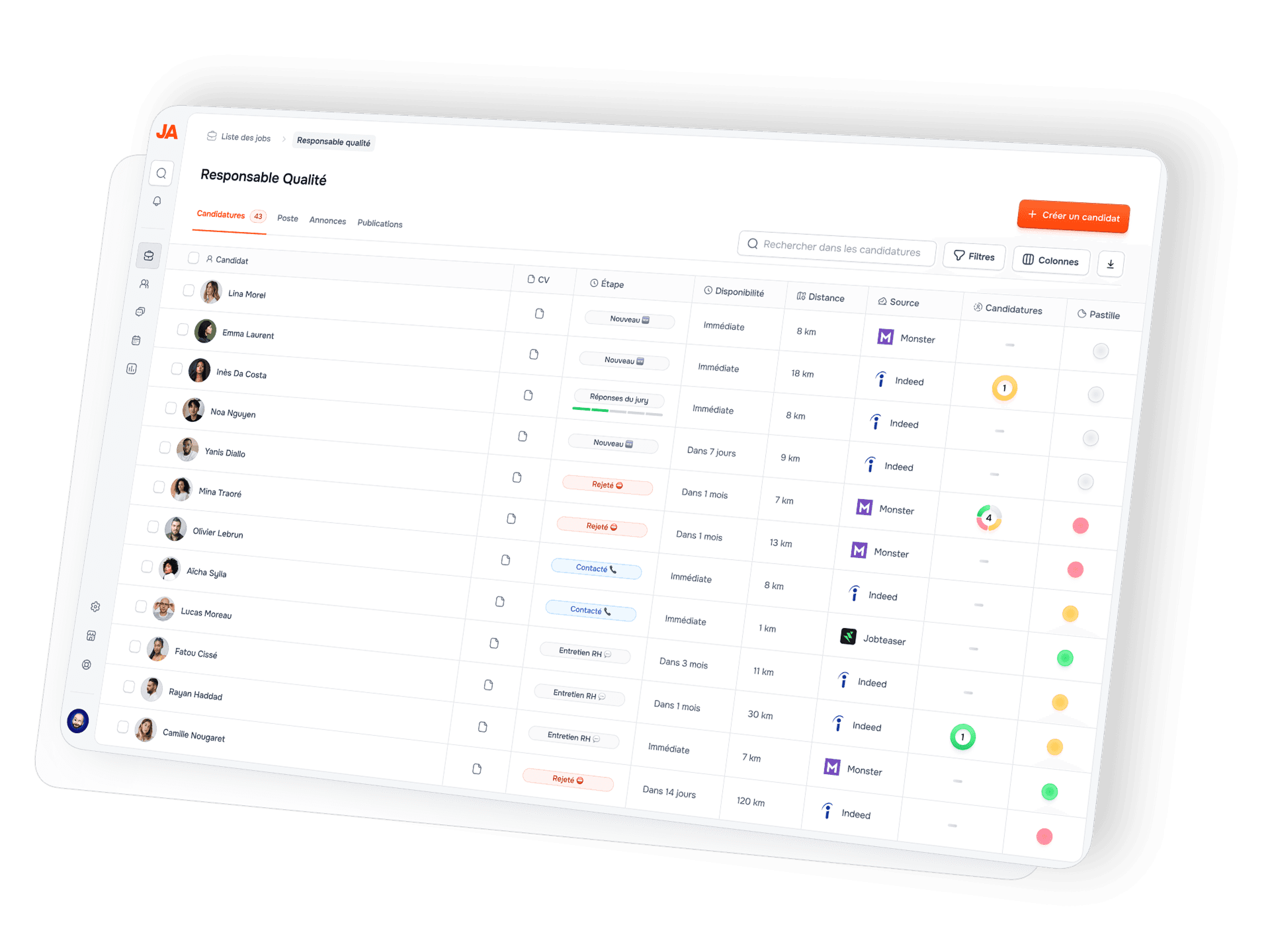

The ATS that simplifies your recruitment