Employer branding and AI: when your hiring process betrays your promises


 5 min read
You spent weeks polishing your careers page. Employee testimonials, team photos, values displayed in bold. A candidate arrives, impressed. They apply. Then, silence. Their resume was discarded in 4 seconds by an algorithm. They will never know. Your career site promised a real conversation. Your process delivered a wall.
This scenario is not an exception. It is becoming the norm.
The invisible gap between the showcase and the back office
The numbers tell a story many companies would rather not hear. 88% of candidates say employer branding influences their decision to apply (DemandSage, 2026). In other words, your career site works. It attracts, it engages, it generates interest.
But on the other side, 42% of candidates trust AI-assisted recruitment less than a human-led process (Omni RMS, Candidate Experience Report 2026). And 66% of American adults say they would not apply for a position if the company uses AI to make hiring decisions.
Companies invest in the storefront. They automate the back office. And they wonder why candidates do not come back.
It is like opening a fine dining restaurant with a stunning facade, then serving frozen meals in the kitchen. The candidate has had a taste. They know.
What algorithmic opacity does to your reputation
The problem is not AI. The problem is the silence it generates.
73% of candidates never received any response after applying (Eurotribune/Yaggo, 2026). 68% were ghosted after an interview. AI, supposedly there to streamline the process, actually amplifies ghosting on an industrial scale. A human recruiter who does not call back is negligent. An algorithm that screens 500 resumes and sends zero feedback is a system.
And candidates notice. 32% fear that AI will reject their application even when their profile matches the role (Culture RH). This is no longer distrust. It is resignation.
Your "Our values" page displays "care" and "respect." Your ATS sends automated rejections without explanation, or worse, sends nothing at all. Candidates do not read your values. They experience your process.
The typical case: the SME that does everything right, except this
Consider an 80-employee company. It invested in Paradisiak for its career site. A team video, a polished culture page, well-written job postings. The image is consistent and attractive. Applications come in.
But internally, the screening process relies on a hastily configured AI filter. Mandatory keywords, automatic scoring, a low rejection threshold. The result: non-traditional but relevant profiles are eliminated before a human ever sees them. And no rejected candidate receives an explanation.
On Glassdoor, the reviews start piling up: "Opaque process," "No feedback after applying," "You wonder if a human ever read your resume."
29% of candidates would abandon a process they consider too automated (Omni RMS). This is not an abstract statistic. It is one in three candidates leaving your funnel before even reaching the interview stage. Your employer brand did its job attracting talent. Your process sabotaged it in the next round.
The exercise that changes everything: test your own candidate journey
Before you keep investing in employer branding, run a simple test. Apply to one of your own job postings. Not as the HR director with backstage access, but as a real candidate, using a neutral email address.
Count the friction points:
- How many clicks before reaching the application form?
- Does anyone explain how your application will be evaluated?
- Do you receive an acknowledgement?
- If rejected, do you receive a message? With an explanation?
- Is the tone of automated communications consistent with your careers page?
If the answer to more than two of these is "no," your employer brand has an integrity problem. Not one of malice, but of consistency.
AI is not the enemy. Opacity is.
Let us add nuance. AI in recruitment can be a tremendous accelerator. It sorts faster, spots weak signals, reduces administrative burden. The point is not to remove it, but to own it.
51% of candidates say they are more likely to apply when a company is transparent about its AI usage (HelloWorkPlace, 2026). Transparency is not a handicap. It is a trust filter.
The European AI Act, which is being progressively enforced for high-risk systems (recruitment is one of them), will make this transparency mandatory. Better to get ahead of it than to be caught off guard.
In practice, this means three things:
Explain. "Your application will first be analyzed by our screening tool, then reviewed by our recruitment team." One sentence. Not a novel. Just honesty.
Respond. Even an automated rejection is better than silence. 74% of candidates prefer a clear "no" over no answer at all. Your AI can generate that message. It might as well serve that purpose too.
Audit. Regularly review your algorithm's decisions. Which profiles are systematically rejected? Are there biases related to education, location, or career path? If 59% of workers believe AI worsens bias (SHL), the doubt is already planted. It is up to you to prove otherwise.
Your career site cannot lie forever
Employer branding is a promise. The candidate experience is the proof. When the two diverge, the proof always wins.
Your career site is the most polished page of your company. But if the candidate who clicks "Apply" enters an opaque tunnel with no feedback, no explanation, and no human touch, that polished page becomes a reproach.
The good news: companies that own their use of AI and maintain human contact throughout the process already stand out. In a market where only 26% of candidates trust AI to evaluate them fairly, transparency is a competitive advantage.
Run the test on your own site. Count the silences. And ask yourself: if you applied here, would you feel respected?
Boost the performance of your recruitment
An exceptional career site to enhance your employer brand and captivate your future talents
Frequently asked questions
Does AI in recruitment scare off candidates?
Not AI itself, but its opaque use. According to the Omni RMS 2026 study, <strong>42% of candidates</strong> trust AI-assisted recruitment less than a human-led process, and <strong>29% would abandon</strong> a process they deem too automated. Transparency about AI usage is the key factor.
How does AI affect employer branding?
AI creates a gap between the promise (a warm career site, human-centered values) and the reality (algorithmic screening, rejection without feedback). <strong>88% of candidates</strong> judge a company by its employer brand before applying. When the process contradicts the showcase, trust collapses.
Should companies communicate about their use of AI in recruitment?
Yes. According to HelloWorkPlace, <strong>51% of candidates</strong> say they are more likely to apply when a company is transparent about its AI usage. Transparency is not a risk, it is a competitive advantage. The European AI Act will make this transparency mandatory.
Does the European AI Act apply to recruitment tools?
Yes, AI systems used in recruitment are classified as high-risk under the AI Act. The progressive enforcement requires companies to guarantee transparency, explainability of algorithmic decisions, and the absence of discriminatory bias in their applicant screening tools.
How can you test the consistency between your employer brand and your recruitment process?
Apply to one of your own job postings using a neutral email address. Check the number of clicks before reaching the form, whether you receive an acknowledgement, the delay and content of any rejection, and whether the tone matches your careers page. If more than two of these fall short, there is a consistency gap to fix.
What is the link between candidate ghosting and AI usage?
<strong>73% of candidates</strong> never received any response after applying and <strong>68%</strong> were ghosted after an interview. AI amplifies this phenomenon by processing massive volumes of applications without individual feedback, turning occasional negligence into an automated system of silence.
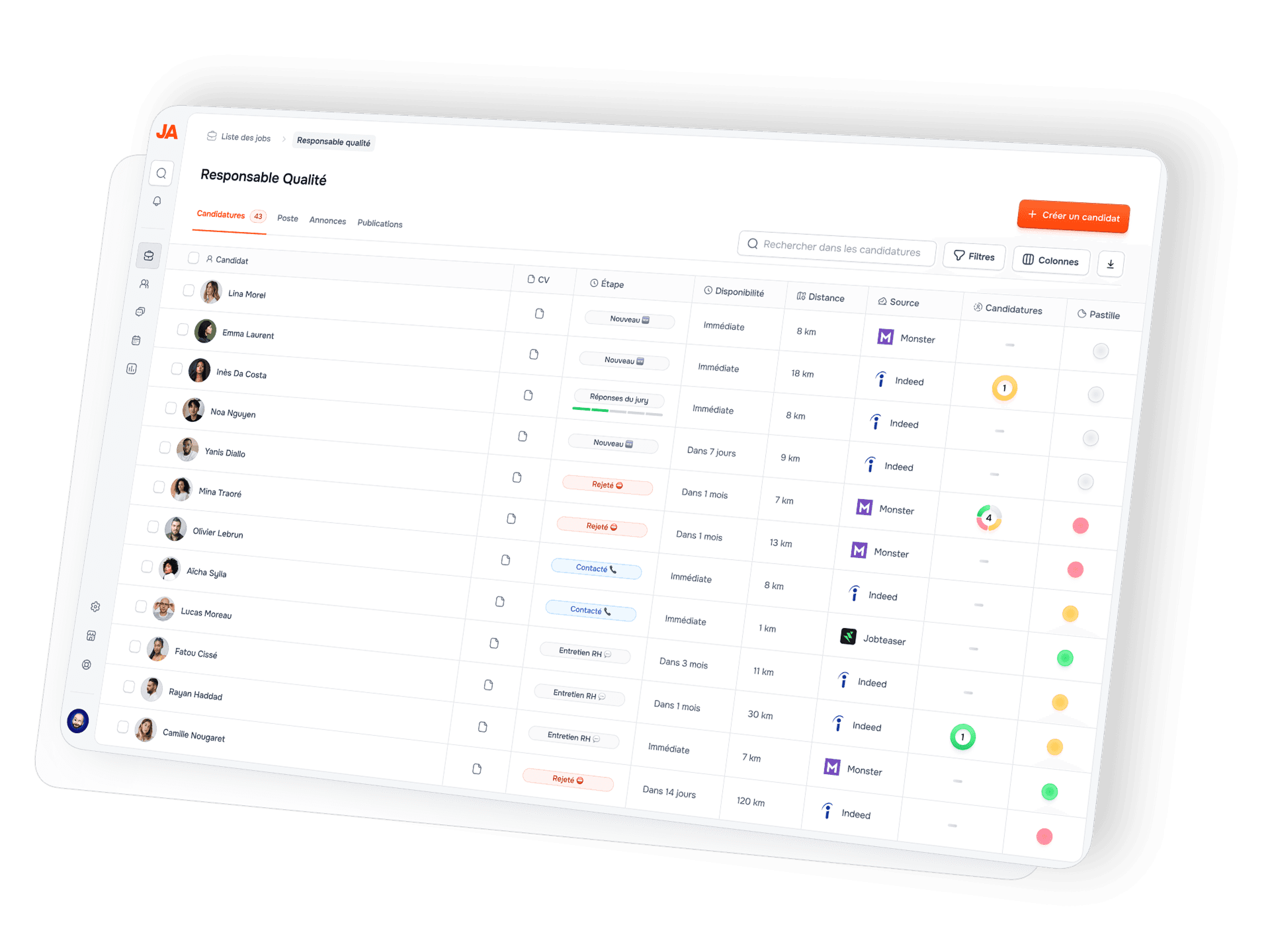

The ATS that simplifies your recruitment